New article
Reconsidering the Origins of Haṭha Yoga
A two-part exploration of the latest scholarship into the origins of Haṭha Yoga, Buddhism, Tantra and medieval India.
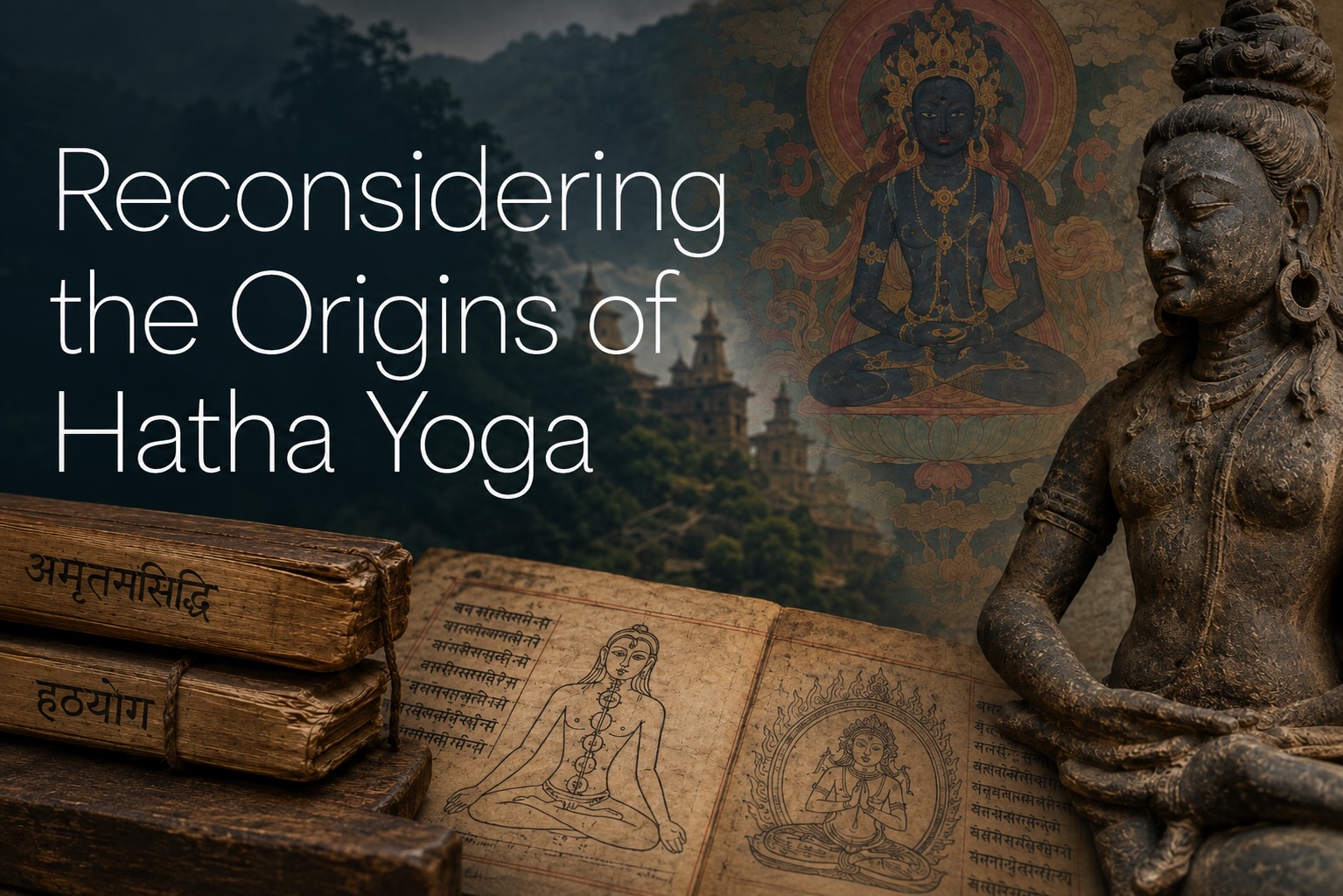
Part One: The Forgotten Buddhist Origins of Physical Yoga
For most modern practitioners, the history of Haṭha Yoga appears straightforward. Yoga began with the ancient Hindu sages, evolved through medieval India and eventually gave rise to the postural traditions practised in studios around the world today. It is a compelling story, but it is not the story that current scholarship tells.
During the last two decades, historians working with newly discovered Sanskrit manuscripts have radically revised our understanding of Haṭha Yoga's origins. Rather than emerging fully formed within Hindu traditions, the earliest recognisable system of Haṭha Yoga appears to have developed within a shared tantric environment in which Buddhist and Śaiva practitioners exchanged methods, terminology and ritual technologies with remarkable freedom.
This does not mean that Haṭha Yoga is "really Buddhist" or that Hindu traditions merely borrowed someone else's practices. Such conclusions are too simplistic. Instead, the evidence reveals something much more interesting: medieval India was home to a vibrant spiritual culture in which religious boundaries were often fluid, innovation was constant and yogic techniques circulated across communities that modern readers tend to imagine as sharply separated.
Understanding this shared heritage not only changes our view of history. It also invites us to reconsider what yoga has always been: a living tradition shaped by dialogue, experimentation and continual transformation.
The Traditional Story
Until relatively recently, most histories of yoga traced Haṭha Yoga directly back to ancient Hindu sources such as the Yoga Sūtras of Patañjali or the Upaniṣads. Medieval texts like the Haṭhapradīpikā were understood as later developments within an essentially Hindu lineage, preserving ancient techniques that had gradually evolved over centuries.
This picture seemed entirely reasonable. The surviving Haṭha Yoga manuals were almost exclusively copied by Hindu scribes. They invoke Śiva as the first teacher of yoga. Many later practitioners belonged to Śaiva or Nāth communities. Modern yoga schools likewise inherited their practices largely through Hindu lineages.
Yet historians gradually noticed an uncomfortable problem. The earliest surviving Haṭha Yoga manuals are surprisingly late. Most date from the fourteenth century onwards, while many of the techniques they describe appear to have emerged several centuries earlier. Somewhere between the classical yoga of Patañjali and the medieval manuals lay a missing chapter in yoga's history. The search for that missing chapter has transformed the field.
A Manuscript That Changed Everything
One of the most significant discoveries came through the work of Professor James Mallinson and Professor Péter-Dániel Szántó on a little-known Sanskrit text called the Amṛtasiddhi, probably composed during the eleventh century.
Unlike later Haṭha Yoga manuals, the Amṛtasiddhi is unmistakably Buddhist. Its language, philosophical framework and manuscript tradition firmly place it within Vajrayāna Buddhism. Yet it also describes practices that would later become defining features of Haṭha Yoga.
These include techniques for manipulating vital winds (prāṇa), sealing bodily energies through bandhas, controlling subtle channels (nāḍīs) and preventing the downward flow of life-giving nectar (amṛta). The body is presented not merely as something to transcend but as a sophisticated energetic system that can be transformed through disciplined practice.
Many of these ideas later appear in Hindu Haṭha Yoga texts, sometimes almost unchanged.
This discovery raised an obvious question.
If the earliest systematic presentation of these techniques appears in a Buddhist text, what does that tell us about the origins of Haṭha Yoga?
Mallinson and Szántó are careful not to claim that Buddhism "invented" Haṭha Yoga in its entirety. Instead, they demonstrate that the Amṛtasiddhi represents the earliest known coherent exposition of practices that later became central to the Haṭha Yoga tradition. It therefore occupies a foundational place in the history of physical yoga.
The critical point is chronological. The Amṛtasiddhi predates the major Hindu Haṭha Yoga manuals by several centuries, suggesting that at least some defining yogic technologies were first systematised within Buddhist tantric circles before being adopted and adapted by Śaiva practitioners.
Medieval India Was Not Religiously Divided
One reason this conclusion surprises modern readers is that we often imagine medieval religions as isolated traditions competing against one another.
The historical reality was considerably more complex.
Between the ninth and thirteenth centuries, tantric Buddhism and tantric Śaivism flourished alongside one another across much of the Indian subcontinent. Yogins travelled between courts, pilgrimage centres and monastic institutions. Teachers debated one another, borrowed effective techniques and sometimes held multiple religious affiliations during their lives.
The religious landscape resembled less a collection of separate institutions than a network of overlapping communities sharing languages, symbols and contemplative technologies.
The historian Alexis Sanderson has spent decades documenting this remarkable exchange. His research demonstrates that Buddhist tantric traditions borrowed extensively from Śaiva ritual systems while Śaiva communities likewise adopted Buddhist innovations. Rather than existing in isolation, both traditions participated in a continuous process of mutual influence.
This exchange extended far beyond philosophy.
Meditation methods, ritual gestures, visualisations, subtle body theories, initiation ceremonies and yogic practices all circulated across sectarian boundaries. Teachers were often far more interested in whether a practice worked than in preserving rigid doctrinal purity.
In such an environment, asking whether a particular yogic technique was "Hindu" or "Buddhist" can be rather like asking whether modern algebra belongs to one nation. Intellectual traditions frequently evolve through collaboration, adaptation and shared experimentation.
Haṭha Yoga appears to be one such tradition.
The Shared Tantric Body
One of the clearest signs of this shared world lies in how both Buddhist and Śaiva traditions understood the human body.
Earlier Indian philosophy often regarded the body as something temporary, unstable or ultimately transcended. Tantric traditions introduced a different vision.
The body became a sacred microcosm containing subtle channels (nāḍīs), centres of consciousness, vital winds and latent spiritual power. Liberation was no longer pursued solely through philosophical insight or renunciation but through direct transformation of the practitioner's embodied experience.
Within this framework, breath became a vehicle of awakening.
Energy could be directed.
Consciousness could be stabilised.
The ordinary body itself became the site of profound spiritual realisation.
The Amṛtasiddhi presents exactly this vision. Its practices seek to unite vital winds, arrest the dissipation of life force and awaken an immortal dimension already present within the practitioner.
Later Hindu Haṭha Yoga manuals adopt the same energetic vocabulary, although they often reinterpret it within Śaiva theological frameworks. The techniques remain recognisable even as their religious explanations evolve.
This is precisely what historians would expect when one tradition inherits and reshapes another's practical methods.
From Buddhist Text to Hindu Tradition
If many early techniques emerged within Buddhist tantric circles, why is Haṭha Yoga now almost universally associated with Hinduism?
The answer lies in history.
From around the twelfth century onwards, institutional Buddhism gradually declined across much of India due to changing political circumstances, shifting patterns of patronage and repeated invasions that devastated major monastic centres. As Buddhist communities disappeared from many regions, their contemplative practices did not necessarily vanish with them.
Instead, many techniques were preserved by Śaiva ascetics, Nāth yogins and other Hindu practitioners who integrated them into their own developing systems.
This process was not unusual. Throughout history, religious traditions have frequently absorbed the teachings of neighbouring communities. Ideas survive because practitioners continue to find them valuable, even when their original institutional settings disappear.
By the time influential manuals such as the Haṭhapradīpikā were composed during the fifteenth century, Haṭha Yoga had become firmly established within Hindu contexts. The text invokes Śiva as the primordial teacher and draws heavily upon Nāth traditions. Yet careful textual comparison reveals echoes of much earlier Buddhist sources beneath its surface.
Modern scholarship therefore paints a picture not of replacement but of continuity through adaptation.
The practices survived because they proved effective.
The religious language surrounding them gradually changed.
A More Interesting History
The question "Was Haṭha Yoga invented by Hindus?" assumes that spiritual traditions emerge in isolation before remaining unchanged for centuries.
History rarely works that way.
The earliest evidence suggests that Haṭha Yoga arose within a rich tantric environment where Buddhist and Śaiva practitioners continually influenced one another. Some of its defining methods appear first in Buddhist literature. Others developed within Śaiva circles. Still others almost certainly evolved through collaboration between communities whose boundaries were far more permeable than we often imagine today.
Far from diminishing the significance of Hindu yoga traditions, this richer history reveals their extraordinary capacity to preserve, refine and transmit powerful contemplative technologies across nearly a thousand years.
In Part Two, we shall explore how newly discovered manuscripts have further transformed our understanding of Haṭha Yoga, why early yoga involved far more physical practices than previously believed and what these discoveries mean for anyone practising yoga today.
Part Two: How a Shared Tradition Became Modern Yoga
The discovery of the Amṛtasiddhi was only the beginning of a much larger scholarly revolution. As historians began examining hundreds of previously neglected Sanskrit manuscripts preserved in libraries across India and Nepal, it became increasingly clear that the early history of Haṭha Yoga was far richer and more diverse than anyone had imagined.
Far from emerging fully formed in a handful of famous texts, Haṭha Yoga evolved gradually through centuries of experimentation. Practices were refined, expanded and transmitted across Buddhist and Hindu communities before eventually becoming associated primarily with the Śaiva and Nāth traditions that preserved them into the early modern period.
One of the scholars at the forefront of this research is Dr Jason Birch, whose painstaking study of early yoga manuscripts has transformed our understanding of how Haṭha Yoga developed.
Jason Birch and the Missing History of Haṭha Yoga
For many years, historians assumed that works such as the Haṭhapradīpikā represented the beginning of Haṭha Yoga. Birch's research has demonstrated that this is far from the case.
By identifying and editing numerous forgotten Sanskrit texts, Birch has shown that many practices associated with Haṭha Yoga were already circulating centuries before the fifteenth century. Rather than discovering a single founding text, scholars have uncovered an evolving family of traditions, each contributing new methods while preserving older ones.
Perhaps most importantly, Birch's work shows that there was never a single, fixed definition of Haṭha Yoga.
Different communities emphasised different techniques.
Some prioritised breath retention.
Others focused on energetic seals known as bandhas.
Others developed methods involving mudrās, visualisation, mantra or physical postures.
The tradition was creative rather than static. Its practitioners were not attempting to preserve an unchanging system but continually adapting practices in response to experience and insight.
This flexibility may explain why Haṭha Yoga survived while many other medieval contemplative traditions disappeared.
The Dawn of Physical Yoga
The latest contribution to this field comes from Professor Giacomella Orofino in The Dawn of Physical Yoga (2025), one of the most important studies of medieval yoga published in recent years.
Drawing upon newly examined manuscripts, Orofino demonstrates that physical yoga developed much earlier than previously believed.
Contrary to the common assumption that early yoga involved little more than seated meditation, medieval practitioners cultivated an impressive range of bodily techniques intended to transform both body and mind.
Her work identifies an astonishing catalogue of 108 physical practices described in early sources.
These include dynamic movements, seated postures, balancing techniques, inverted positions, methods for strengthening the abdomen, specialised breathing exercises, energetic locks, cleansing techniques and subtle bodily manipulations.
Many of these practices bear little resemblance to the flowing posture sequences familiar in modern yoga studios. They were not primarily designed for flexibility or fitness. Instead, they were understood as precise technologies for influencing consciousness through the body.
The practitioner sought to regulate vital winds, awaken dormant energy, stabilise attention and ultimately attain liberation.
In other words, physical practice was never regarded as an end in itself.
It was a vehicle for profound contemplative transformation.
Why Āsana Was Only One Part of the System
Modern yoga often treats āsana as the defining feature of practice.
Historically, however, posture occupied a far more modest place.
Early Haṭha Yoga manuals typically devote much more attention to breath regulation, mudrās, subtle anatomy and meditation than to postural instruction.
The Haṭhapradīpikā, perhaps the best known medieval manual, describes only fifteen principal āsanas.
The Gheraṇḍa Saṃhitā expands this number.
Later texts continue the process.
Yet throughout this literature, postures are consistently presented as preparation for deeper internal work rather than the culmination of yoga itself.
The body is trained so that breath can become steady.
Breath becomes steady so that the mind becomes still.
When the mind becomes still, deeper states of awareness naturally emerge.
This progression reflects a sophisticated psychophysical understanding that differs markedly from the way yoga is often presented today.
Modern postural yoga undoubtedly offers considerable physical and psychological benefits. Nevertheless, the historical sources remind us that posture originally formed only one component within a much broader contemplative discipline.
The Nāths as Great Preservers
If early Haṭha Yoga emerged within a shared Buddhist and Śaiva environment, why do later generations remember it almost exclusively as a Nāth tradition?
The answer lies in preservation.
While institutional Buddhism gradually declined within India, Nāth yogins continued copying manuscripts, transmitting practices and training new generations of practitioners.
Figures such as Matsyendranātha and Gorakṣanātha became central symbols of the tradition, even though the historical development of Haṭha Yoga was almost certainly more complex than later legends suggest.
The Nāths did not simply preserve earlier teachings unchanged.
They refined them.
Expanded them.
Integrated them into distinctive Śaiva frameworks.
Created new practices.
Systematised older ones.
In many respects, they became the great custodians of Haṭha Yoga.
Without their efforts, much of the tradition might have disappeared entirely.
Recognising earlier Buddhist influences therefore does not diminish the importance of the Nāths. Instead, it highlights their remarkable role in preserving and transmitting a sophisticated body of knowledge that had developed over centuries.
Was Haṭha Yoga Invented by Hindus?
The historical evidence suggests that the answer depends entirely on what we mean by "invented."
If we are asking whether the complete system known today as Haṭha Yoga suddenly appeared within Hinduism, the answer is clearly no.
If we are asking whether Buddhist practitioners alone created the tradition, the answer is equally no.
Instead, Haṭha Yoga appears to have emerged within a shared tantric culture where Buddhist and Śaiva practitioners continually exchanged ideas, techniques and methods of practice.
Some of its earliest documented technologies appear in Buddhist sources such as the Amṛtasiddhi.
Many were subsequently developed, expanded and preserved within Śaiva and Nāth communities.
Later manuals synthesised centuries of innovation into increasingly comprehensive systems.
Modern yoga therefore inherits a tradition that is simultaneously Buddhist, Śaiva, Nāth and uniquely yogic.
Attempting to assign exclusive ownership to one religious community oversimplifies a history that is both more collaborative and more fascinating.
What This Means for Modern Practitioners
For contemporary students, these discoveries offer an opportunity rather than a challenge.
They remind us that yoga has always evolved.
Its history is not one of rigid preservation but of creative adaptation grounded in sustained practice.
Throughout the medieval period, yogins borrowed methods that proved effective regardless of their sectarian origin. They remained committed to direct experience above ideological purity.
Perhaps this explains why Haṭha Yoga has continued to flourish for nearly a millennium.
Its strength has never depended upon belonging exclusively to one religion.
Its enduring power lies in its practical exploration of the relationship between body, breath, attention and consciousness.
Whether practised in a Buddhist monastery, a Śaiva temple, a Nāth monastery or a modern yoga studio, the essential question remains remarkably similar.
Can disciplined work with the body transform the mind?
The medieval yogins believed it could.
Modern neuroscience increasingly suggests they may have been right.
A Shared Inheritance
The latest scholarship has not rewritten the history of Haṭha Yoga by replacing one origin story with another.
Instead, it has revealed a far richer narrative.
Haṭha Yoga did not emerge in isolation.
It developed within one of the most intellectually and spiritually creative periods of Indian history, where Buddhist and Hindu practitioners shared techniques, challenged one another and continually refined methods of contemplative practice.
The Nāth yogins inherited this evolving tradition and ensured its survival.
Later generations transmitted it across India.
In the twentieth century it spread throughout the world.
Understanding this history deepens rather than diminishes our appreciation of yoga. It reminds us that genuine spiritual traditions rarely belong to a single individual or community. They emerge through centuries of dialogue, experimentation and lived experience.
Haṭha Yoga is best understood not as the exclusive possession of one religion but as one of humanity's great contemplative achievements: a tradition shaped by many hands, refined across generations and still evolving today.
Further Reading
For readers who would like to explore this subject in greater depth, the following works represent some of the most important scholarship on the early history of Haṭha Yoga and the interaction between Buddhist and Śaiva tantric traditions.
- Birch, Jason. Publications on early Haṭha Yoga manuscripts, textual history and the development of physical yoga. Available through the Haṭha Yoga Project: https://hyp.soas.ac.uk/publications/
- Mallinson, James. Haṭhayoga's Early History (2020), along with other publications available through the Haṭha Yoga Project: https://hyp.soas.ac.uk/publications/
- Mallinson, James & Szántó, Péter-Dániel. The Amṛtasiddhi and Amṛtasiddhimūla: The Earliest Texts of the Haṭha Yoga Tradition (2021). Available at: https://www.academia.edu/45570629/The_Am%E1%B9%9Btasiddhi_and_Am%E1%B9%9Btasiddhim%C5%ABla
- Orofino, Giacomella. The Dawn of Physical Yoga: Dispelling the Hindrances of Immortality (2025). Open access: https://yogaresearch.org/document/the-dawn-of-physical-yoga-dispelling-the-hindrances-of-immortality/
- The Haṭha Yoga Project (SOAS). A major international research project exploring the textual history and evolution of Haṭha Yoga: https://hyp.soas.ac.uk/
- SOAS Lecture: The Dawn of Physical Yoga, featuring Giacomella Orofino and Jason Birch, discussing recent discoveries and their implications for the history of yoga: https://www.soas.ac.uk/about/event/dawn-physical-yoga-giacomella-orofino
- Sanderson, Alexis. Foundational studies on the relationship between Buddhist and Śaiva Tantra, particularly his work on the mutual exchange of tantric doctrines and practices. Many of his publications are available through the University of Oxford and Academia.edu.
- Hatha Yoga
- Yoga History
- Tantra
- Buddhism
- Shaiva Tantra
- Meditation
- Philosophy
- Research
- Writings
Author
Written by Deva Murti
Teacher of Tantric Yoga, Meditation, Circling and Non-dual Shaiva Tantra.
More about Deva →Related writings
On Tantra, meditation, yoga philosophy and Non-dual Shaiva Tantra.